Financial Statement Analysis
Use of statements, ratios, and trend review to interpret a business's profitability, liquidity, leverage, and operating quality.
Definition
Financial statement analysis is the process of using financial statements, ratios, and trend review to interpret a business’s performance and financial position. The goal is not just to read the statements, but to understand what the numbers imply.
Why It Matters
Statement analysis helps readers move from raw accounting data to decision-useful judgment. It supports credit review, management oversight, benchmarking, and the detection of unusual trends or reporting risks.
How It Works In Accounting Practice
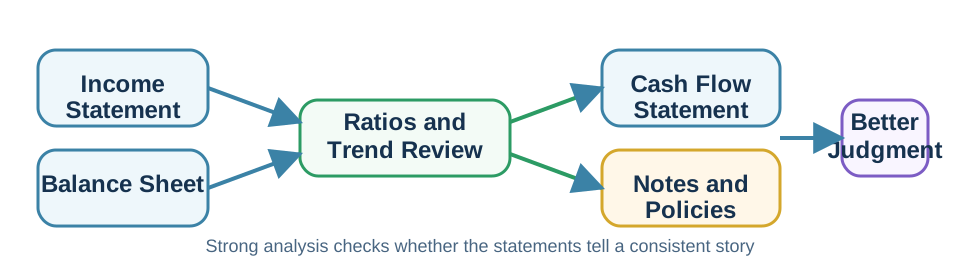
Analysts usually compare profitability, liquidity, leverage, and efficiency measures across periods or against peers. They also look at note disclosures, accounting policy choices, unusual items, and the relationship between the income statement, balance sheet, and cash flow statement.
Good analysis combines ratios with context. A single number rarely explains the whole story without understanding the business model and the accounting behind it.
| Analysis Lens | Main Question | Common Source |
|---|---|---|
| Profitability | Did the business earn enough from its operations? | Income statement |
| Liquidity | Can it meet short-term obligations? | Balance sheet and cash flow statement |
| Efficiency | How well are receivables, inventory, and other resources being used? | Ratios built from statements |
| Quality of earnings | Does reported profit convert into cash and sustainable performance? | Cross-statement review |
Simple Example
A company may report rising profit while cash flow weakens and receivables rise sharply. Statement analysis would flag that pattern for closer review because revenue quality or collection timing may be changing.
| Signal | Year 1 | Year 2 | Why It Matters |
|---|---|---|---|
| Revenue | 1,200,000 | 1,350,000 | Top line improved |
| Net income | 90,000 | 115,000 | Profit appears stronger |
| Operating cash flow | 105,000 | 62,000 | Cash conversion weakened |
| Accounts receivable | 140,000 | 240,000 | Collections may be slowing |
Looking across the statements is what turns those line items into a meaningful judgment.
Common Confusions
Financial statement analysis is not just formula memorization. It also requires understanding accounting policies, business context, and why the numbers moved. It is also not limited to one statement. Strong analysis checks whether the income statement, balance sheet, and cash flow statement tell a consistent story.