Contribution Margin
Amount remaining from sales after variable costs, used to cover fixed costs and then contribute to profit.
Definition
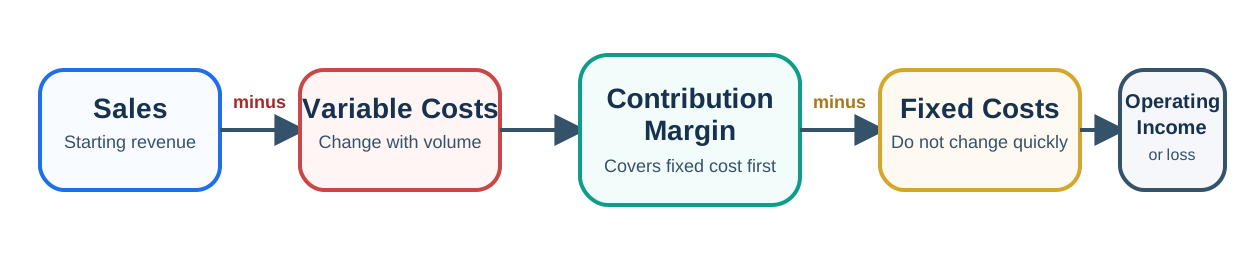
Contribution margin is the amount remaining from sales after variable costs are deducted. That remaining amount first covers fixed costs and then contributes to profit.
Why It Matters
Contribution margin is a core managerial-accounting measure because it helps managers judge pricing, sales mix, special orders, and the volume needed to cover fixed costs. It is especially useful for short-term decision support.
How It Works In Accounting Practice
The measure can be stated per unit or in total. The basic formula is:
\[ \text{Contribution Margin} = \text{Sales} - \text{Variable Costs} \]
Managers also use the ratio form:
\[ \text{Contribution Margin Ratio} = \frac{\text{Contribution Margin}}{\text{Sales}} \]
Managers often pair it with fixed-cost information to evaluate break-even points and target-profit scenarios.
The operating flow is easier to see in the diagram below:
Simple Example
Assume a product line reports 200,000 of sales and 120,000 of variable costs:
| Input | Amount |
|---|---|
| Sales | 200,000 |
| Variable costs | (120,000) |
| Contribution margin | 80,000 |
| Contribution margin ratio | 40% |
| Fixed costs | (50,000) |
| Operating income | 30,000 |
The 80,000 contribution margin covers fixed costs first. Anything remaining after fixed costs becomes operating profit.
Common Confusions
Contribution margin is not the same as gross profit. Gross profit is a financial-statement concept tied to cost of goods sold. Contribution margin is a managerial view built around variable-cost behavior.