Statement of Changes in Equity
Financial statement that explains how equity balances changed during the reporting period.
Definition
The statement of changes in equity is the financial statement that explains how equity balances moved during the reporting period. It typically shows the effects of net income, losses, dividends, owner contributions, share transactions, and other comprehensive income where relevant.
Why It Matters
This statement helps readers understand why ending equity differs from beginning equity. It connects profitability, distributions, and capital activity in a way that the balance sheet alone cannot.
How It Works In Accounting Practice
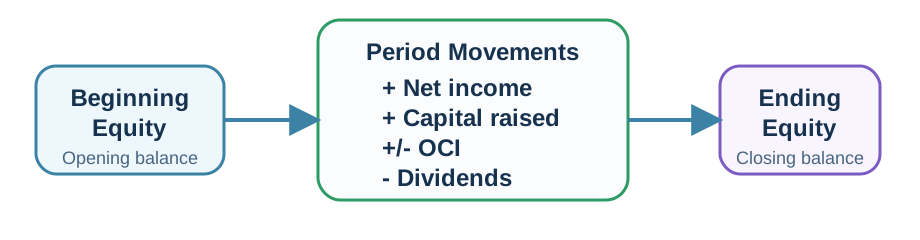
The statement usually begins with opening balances, then shows period movements by equity component before arriving at ending balances. Retained earnings is often a major focus because it captures the accumulation of profit less dividends and other adjustments.
A simplified roll-forward can be expressed as:
\[ \text{Ending Equity} = \text{Beginning Equity} + \text{Net Income} - \text{Dividends} + \text{Capital Contributions} \pm \text{OCI} \pm \text{Other Adjustments} \]
This is why the statement is useful. It isolates the drivers of change instead of leaving readers to infer them from the opening and closing balance sheets alone.
Simple Example
If opening equity is 500,000, the company earns 60,000, pays 15,000 of dividends, and issues 40,000 of new shares, the statement can look like this:
| Equity Component | Opening | Net Income | Share Issue | Dividends | Ending |
|---|---|---|---|---|---|
| Share capital | 300,000 | - | 40,000 | - | 340,000 |
| Retained earnings | 200,000 | 60,000 | - | (15,000) | 245,000 |
| Total equity | 500,000 | 60,000 | 40,000 | (15,000) | 585,000 |
The statement shows not just the ending total, but which equity bucket changed and why.
Common Confusions
This statement is not the same as the balance sheet. The balance sheet shows ending equity at a date. The statement of changes in equity explains how that ending balance was reached over the period. It is also not the same as the cash flow statement, because dividends and share issues may affect both cash and equity, while net income changes equity even when some revenue or expense items are non-cash.