Depreciation
Systematic allocation of a tangible asset's cost over the periods expected to benefit from its use.
Definition
Depreciation is the accounting process of allocating the cost of a tangible long-lived asset across the periods expected to benefit from its use. It does not mean cash is leaving the business again. It means part of the asset’s recorded cost is being recognized as expense over time.
Why It Matters
Depreciation affects profit, asset carrying value, and many performance measures. If it is ignored or estimated poorly, both the income statement and balance sheet can become misleading.
How It Works In Accounting Practice
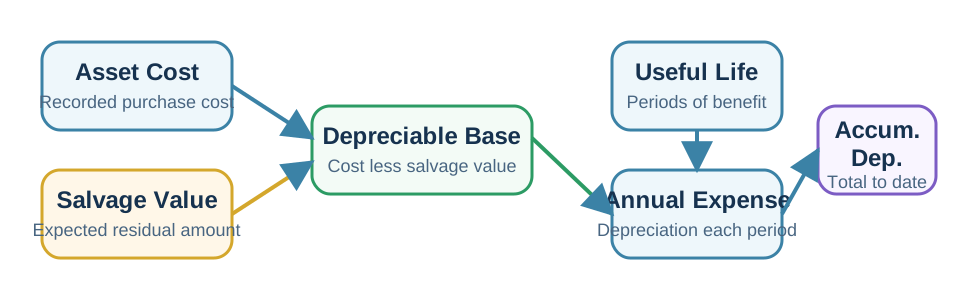
When a business buys equipment, vehicles, or other depreciable property, the cost is usually recorded as an asset first. The cost is then allocated over the asset’s useful life using a method such as straight-line, units of production, or another approach that fits the asset’s pattern of use.
Under straight-line depreciation, the standard calculation is:
\[ \text{Annual Depreciation} = \frac{\text{Cost} - \text{Salvage Value}}{\text{Useful Life}} \]
The credit side of the entry often goes to accumulated depreciation, a contra-asset account that reduces the asset’s carrying amount without erasing the original cost record. That lets the balance sheet keep both the asset’s historical cost and the total cost already allocated to expense.
Simple Example
Equipment costing 24,000 is expected to provide benefit for 12 years with no salvage value.
| Input | Amount |
|---|---|
| Cost | 24,000 |
| Salvage value | 0 |
| Depreciable base | 24,000 |
| Useful life | 12 years |
| Annual straight-line depreciation | 2,000 |
The year-end journal entry is:
| Account | Debit | Credit |
|---|---|---|
| Depreciation Expense | 2,000 | |
| Accumulated Depreciation | 2,000 |
That entry reduces current-period profit on the income statement and increases accumulated depreciation on the balance sheet.
Common Confusions
Depreciation is not the same as market-value decline. Accounting depreciation is an allocation method, not a live appraisal. It is also not the same as amortization, which usually applies to finite-life intangible assets in accounting or to loan principal schedules in lending.